Your tools stay. The manual work between them doesn’t.
A forward deployed engineer (FDE) embedded in your business — building workflow and AI automation inside the systems you already rely on, and shipping it to production. The manual handoffs, duplicate entry, and friction between tools that were never designed to work together: engineered away.
Most automation fails because it targets isolated tasks instead of the full operational flow. We work forward-deployed — embedded in the systems a business already runs — mapping the complete workflow, every decision point, handoff, and exception, then building pipelines that carry the routine. Agentic steps are introduced only where they earn trust, with humans in control where judgment matters. The tools the team relies on stay in place; the work between them is what changes.
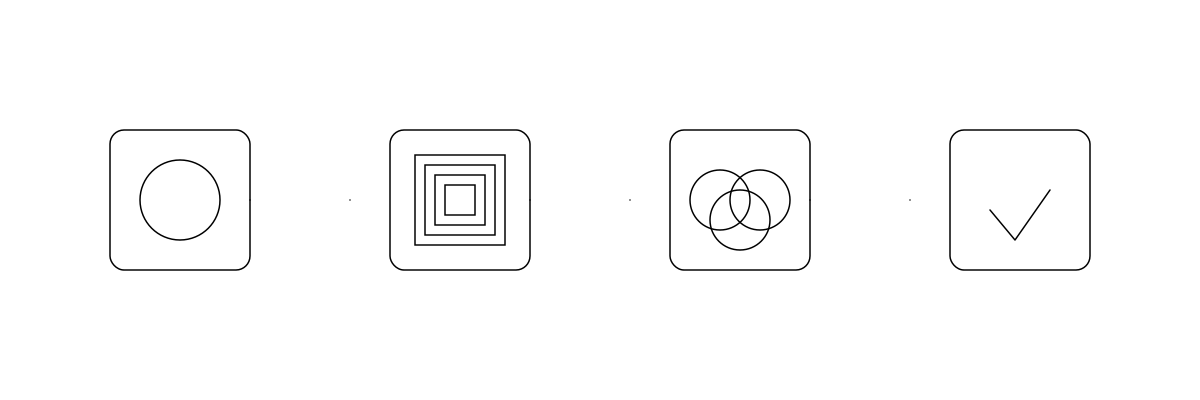
Architecture.
Four layers, executed in order, and shipped to production rather than handed off as a plan. Each depends on the one before it — omit a layer, and the system fails the moment it meets production.
Workflow identification.
Before any code is written, we map the work itself — every repeating process, every decision, every handoff between people and tools. Genuine judgment calls are separated from habitual manual work, so automation targets the latter and supports the former. Success criteria are defined up front, so outcomes are measurable on day one.
Pipeline design.
Each pipeline is built from clearly scoped components — data in, data validated, data routed by content and urgency, data out. Problems surface immediately and are contained at the point of failure; they do not propagate across the rest of the operation.
AI as a second opinion, not a first mover.
Deterministic orchestration runs every automation. The core logic is explicit, auditable, and does not depend on a model staying well-behaved. AI accelerates how the system is built — mapping workflows, drafting handlers, surfacing edge cases during development — and acts as a secondary review layer at runtime, flagging anomalies and offering a second opinion before sensitive actions. AI is never the sole decision-maker. Models change, drift, and fail. The automations do not.
Verification & oversight.
High-impact decisions pass through human review before execution. Outputs are scored against defined confidence bounds; anything outside those bounds is flagged for attention rather than released. Every step is logged and reviewable — nothing about the system is opaque to the business running it.
Integration.
Automation is most valuable when it reinforces the tools a team already relies on — not when it demands they be replaced.
API integrations.
Direct connections to CRMs, ERPs, databases, and communication platforms — with proper contracts, rate-handling, and error behavior built for long-running production use.
Legacy connectors.
Custom adapters for older systems without modern APIs — brought into the same pipeline as everything else, without replacing the tools a team already relies on.
Data sync.
Cross-platform synchronization with deterministic conflict resolution when two sources of truth disagree — the business defines which side wins, and the rule is enforced consistently.
Event-driven triggers.
Real-time triggers keep downstream systems aligned the moment upstream state changes. No manual refresh, no stale data, no scheduled batch windows where the business runs on out-of-date information.
The objective is not automation for its own sake. It is a measurable reduction in time, error, and cost — achieved by connecting what the business already operates, not replacing it. When the problem is not a missing tool but the friction between existing ones, this is the Engagement.
Pricing.
Engagements begin with a paid scoping hour. Build fees and Retainers are quoted from that scope — no open-ended commitments.
| Service | Rate |
|---|---|
Scoping Engagement One hour — audit, workflow mapping, and written scope |
$150 |
Build fee Automation design, integration, testing, and deployment |
From $2,500 |
Retainer Monitoring, refinement, and ongoing support |
From $500 / month |
Built for your world
I run
See exactly how this is assembled for your industry — the outcomes, the setup, and where it fits.
Automate what matters.
Describe the handoffs, the duplicate entry, or the manual work between systems that consumes the most time. The Engagement is scoped from there.
Need someone to operate the system inside your business once it is live? A fractional Engagement places a forward deployed engineer on Retainer — running, refining, and extending the automation as the business grows.